





What's the best height to hang art?
Hang artwork so that the centre of the piece sits 145 to 150 centimetres above the floor — the international gallery standard, also called the 145-centimetre line. The instinct in most South African homes is to hang too high; almost no one hangs too low. Adjust upward only when furniture, ceiling height, or scale genuinely demand it.
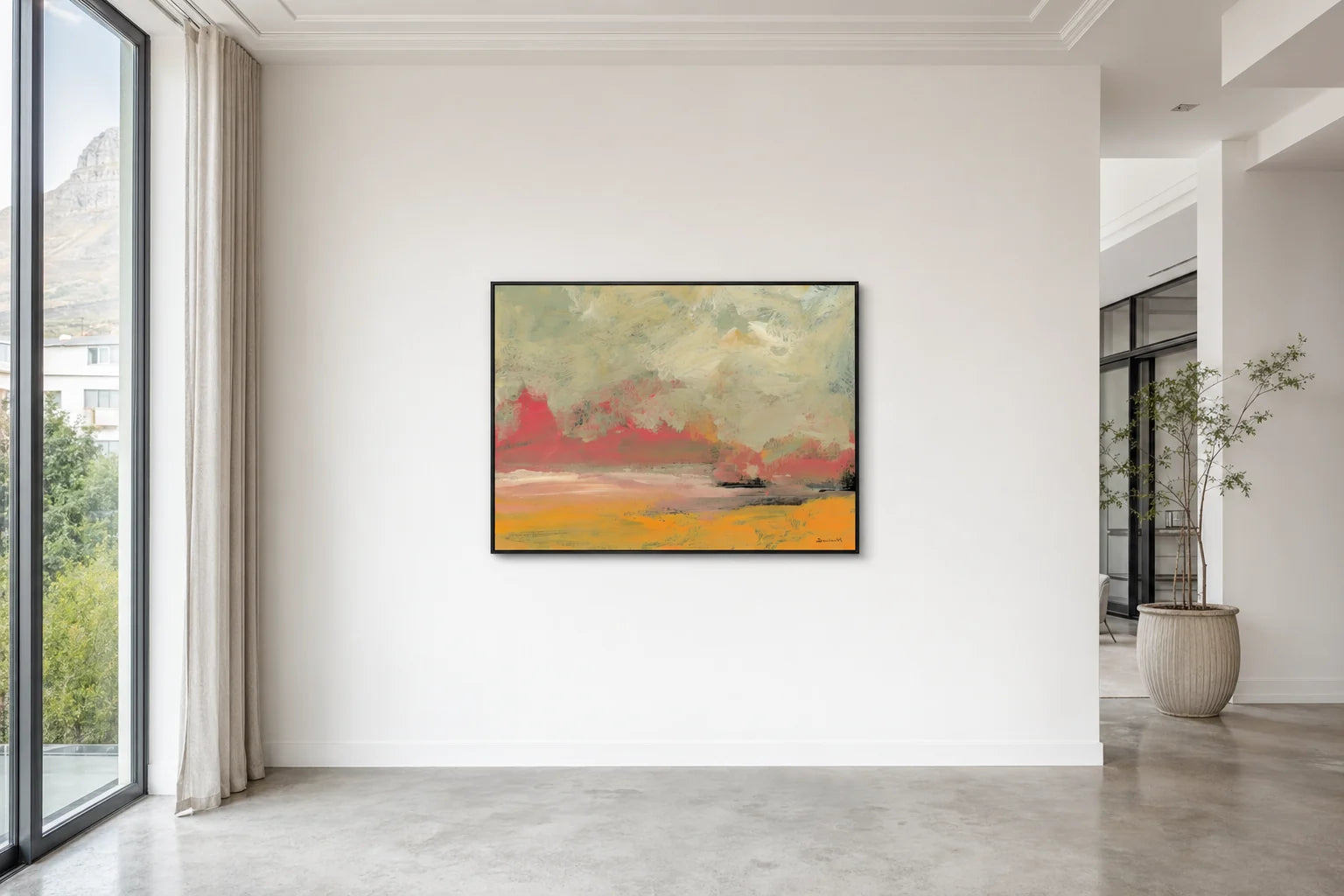
Tropic — A1 Fine Art Paper, framed in black Obeche — hung at the gallery eye-line in a Cape Town apartment with polished concrete floors and 2.7 m ceilings.
The 145-centimetre centre line
Galleries hang at 145 cm from the floor to the centre of the artwork. It is not a number plucked from the air. It is the average eye level of a standing adult, calibrated so the work sits comfortably in the line of sight whether the viewer is moving past or pausing in front of it.
Most well-hung walls in our experience land between 145 and 150 cm. The five-centimetre window allows for taller households, slightly higher ceilings, and the small adjustments a real room demands. Below 140 cm starts to feel low and museum-corridor; above 155 cm starts to feel as though the artwork is trying to escape.
The number applies to a single piece on an empty wall. The moment furniture enters the conversation, the centre line bends slightly — which is the next section.
When furniture changes the maths
Above a couch, the gap between the back of the couch and the bottom of the frame matters more than the absolute centre line. Aim for 15 to 25 centimetres of breathing room. Closer than 15 cm and the artwork looks pinned to the upholstery; further than 25 cm and it floats away from the composition entirely.
The same logic applies above beds (15 to 30 cm above the headboard), consoles (20 to 30 cm above the surface), and mantelpieces (10 to 20 cm above the shelf). The eye-line rule yields to the furniture-relationship rule, because a wall with furniture is no longer about the wall — it is about the conversation between the two.
The trick is to measure both and split the difference. If 145 cm to centre and 20 cm above the couch back disagree, follow the furniture relationship and let the centre line shift by a few centimetres. The eye notices the gap above the couch long before it clocks the centre line.
If a wall feels off and no one can say why, the artwork is almost certainly hung too high. It usually is.
— A Note from the Studio
Why most South African homes hang too high
Frankly, the most common mistake we see is artwork hung 10 to 20 cm higher than it should be. The reasons are predictable and forgiving: the picture hook ends up where the hammer naturally swings; an existing nail dictates the height; the artwork is hung first and the couch moves in later.
The cure is a tape measure and patience. Mark the wall in pencil at 148 cm. Subtract half the artwork's height. The pencil mark above is where the picture hook goes — not where the top of the frame ends up. A surprising number of well-decorated rooms have one stubborn print hung 15 cm too high, and lowering it is the single cheapest improvement available.
Higher ceilings tempt the opposite mistake: scaling the centre line up to match. Don't. The the gallery eye line of the viewer hasn't moved — only the architecture has.
Three exceptions worth knowing
Stairwells are the first. The centre line shifts to wherever the eye lands as the viewer climbs — usually a diagonal line of frames following the angle of the staircase, each centred at 145 cm above the tread directly below it.
Children's rooms are the second. Drop the centre line to 130 cm or even 120 cm so the artwork is hung for the people who actually live in the room, not the parents who decorated it.
Long horizontal hallways are the third. Where multiple pieces sit in a row, the centre line of each can be aligned along a single horizontal axis at 145 cm — the row reads as a single gesture rather than a series of decisions.

Hanging today?
Photograph the wall with the furniture in place and send it through. We'll mark up the centre line in pencil over the photo, with the picture-hook position calculated for the print size you're considering — back to you within the hour.
Message Nikki on WhatsApp →


