





What are common gallery wall mistakes?
Most gallery walls fail for the same three reasons — they're hung too high, spaced too widely, and matched too neatly. A good gallery wall fills 50–60% of the wall, has one clear anchor piece, and reads as collected rather than curated. Frankly, the best ones look slightly imperfect on purpose.
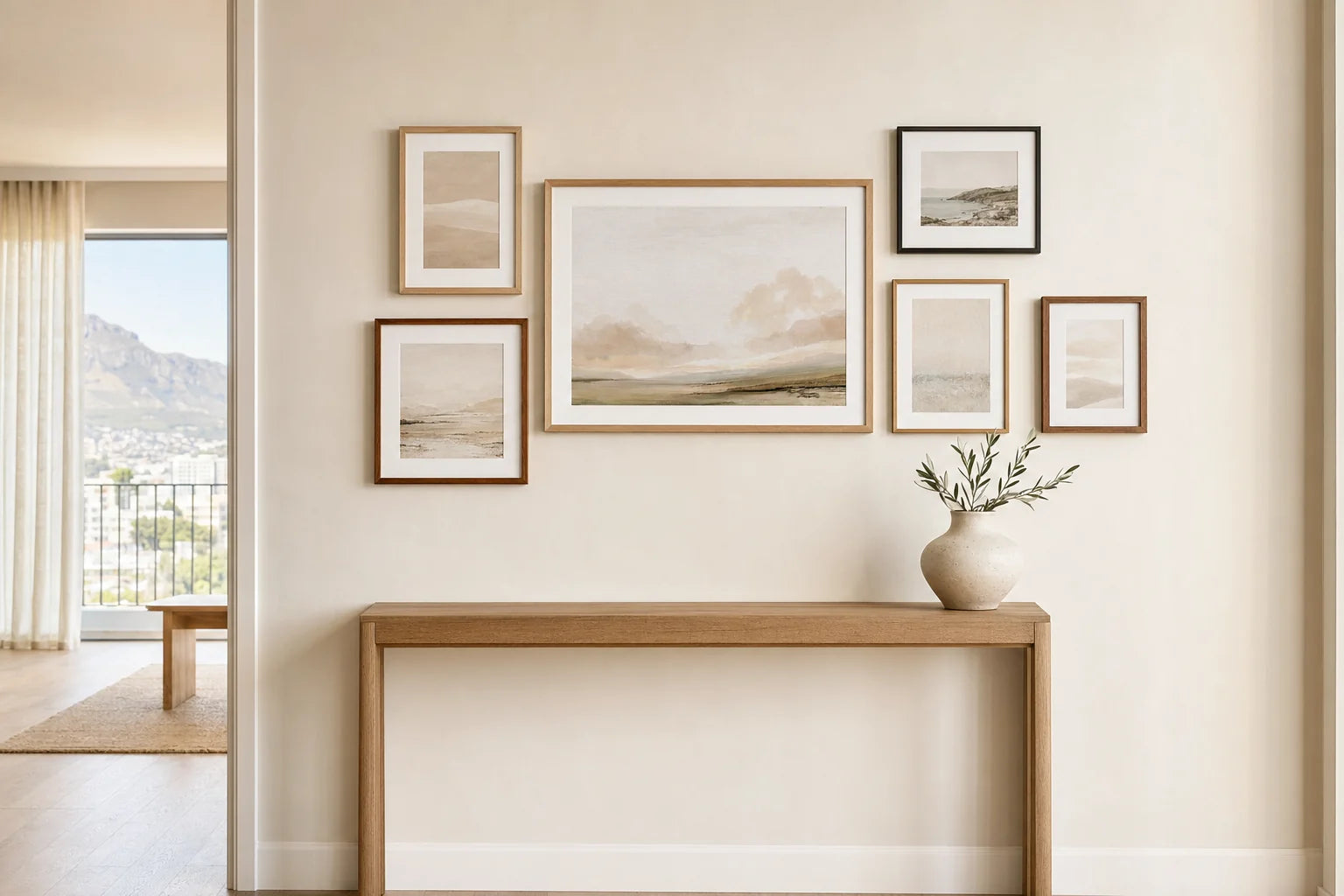
Six prints over a slim console — anchor piece slightly off-centre, mixed timber finishes (white oak, honey-stained, black). Spacing held consistently at 7 cm. The intentional inconsistency is the point.
Hanging the whole composition too high
This is the mistake we see most often. A gallery wall isn't measured to the top piece — it's measured to the centre of the entire arrangement. That centre should sit at 145–150 cm from the floor, the same eye line as a single artwork.
When the top of the composition is treated as the reference point, the whole cluster floats. The room reads as if the art belongs to a taller house. Lay the arrangement out on the floor first, find the visual midpoint, and measure from there.
Matching every frame identically
The instinct is tidy: nine A3 prints, all in the same black frame, evenly spaced. The result is sterile. It reads as decoration applied to the wall rather than a collection that grew over time.
The rooms we see this work in have variation — a black frame next to honey-stain, a wide white moulding beside a slim bronze. The art is doing the work of unifying the wall; the frames are allowed to be themselves. In our experience, three frame finishes across six to eight pieces is the sweet spot.
The best gallery walls look like they were collected over years, not ordered in a single afternoon. A little inconsistency is the point.
— A Note from the Studio
No clear anchor piece
Every gallery wall needs one piece that the eye lands on first. Usually it's the largest. Sometimes it's the most saturated, or the one with the strongest narrative — a portrait among abstracts, a single colour amid a tonal palette.
Without an anchor, the eye scatters. The wall becomes busy without being interesting. Place the anchor slightly off-centre — pure symmetry rarely flatters a gallery wall — and let the smaller pieces orbit it.
Spacing that's too generous
Gallery walls live or die by the gaps. Too tight and the pieces fight each other; too wide and the cluster dissolves into separate artworks pretending to be a group.
Our rule of thumb: 5–7.5 cm between smaller pieces (A4–A3), 10–15 cm between larger ones (A2 and up). Hold the spacing consistent throughout. Inconsistent gaps are what makes a gallery wall feel amateur — even when every other decision is right.
| Mistake | Why it fails | Better instinct |
|---|---|---|
| Hung to the top piece Whole cluster floats | Reads as if the art belongs to a taller room | Measure to the centre 145–150 cm eye line |
| Identical frames throughout | Sterile, applied, decorator-by-numbers | Mix two or three finishes Let frames vary |
| No anchor piece | Eye scatters, wall feels busy | One largest or most saturated piece Slightly off-centre |
| Spacing 15+ cm everywhere | Cluster dissolves into separate artworks | 5–7.5 cm small · 10–15 cm large Hold it consistent |
The five most common gallery-wall mistakes, with the decorator-led correction for each.
Underfilling the wall itself
A six-piece arrangement floating in the middle of a three-metre wall reads as undersized. Gallery walls should occupy 50–60% of the wall — slightly less than a single piece (which sits at 60–75%) because the negative space between frames does some of the visual work.
If the cluster looks small once it's up, the answer is rarely to spread the existing pieces further apart. It's to add one or two more. A gallery wall is a forgiving format — there's almost always room to grow it.

Sketching a gallery wall? Send us the room.
Send a photo of the wall with rough measurements and we'll suggest a composition — piece counts, sizes, frame finishes — that suits the architecture. No pressure, no quote required. Nikki replies on WhatsApp from the Woodstock studio.
Message Nikki on WhatsApp →


