





What is the 2/3 rule for wall art?
The two-thirds rule is the single most useful sizing principle in interior decoration: any artwork hung above a piece of furniture should occupy roughly two-thirds of that furniture's width. Couch, bed, console, mantel — the ratio holds. Multiply the furniture's width in centimetres by 0.66, and the answer is the artwork width to shop within ten centimetres of, either side.
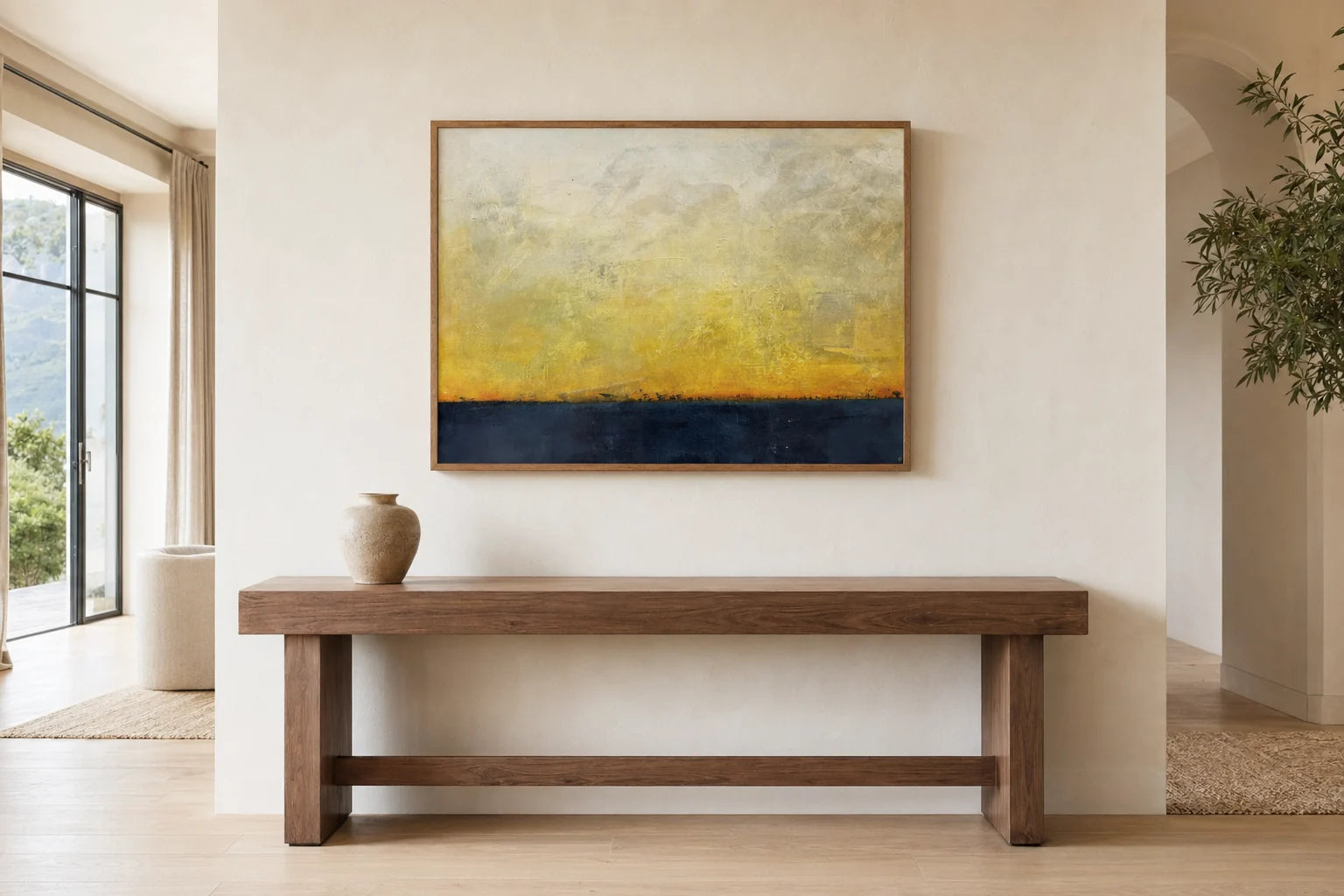
Golden Horizon Abstract — A1 Fine Art Paper, framed in honey-stained Obeche — above a 1.4 m walnut console. Two-thirds applied to a sideboard rather than a couch.
Why two-thirds and not half, not whole
Half a couch's width reads as a postage stamp. The full width reads as wallpaper. Two-thirds sits in the proportional sweet spot the eye has been trained to like long before any of us knew the rule existed — the same ratio that governs the height of a doorway against the wall it sits in, or the way a fireplace mantel relates to the chimney breast above it.
The instinct is older than decorating. Painters call it the rule of thirds; architects call it the golden section's quieter cousin. In a room, it simply means the artwork is _present_ without dominating, and the furniture is anchored without being upstaged.
Anything narrower than 60% of the furniture below makes the artwork look stranded. Anything wider than 80% starts to feel as though it is sitting on top of the piece rather than above it.
Two-thirds is the ratio decorators use when they aren't sure, and the ratio they keep using once they are.
— A Note from the Studio
Where the rule quietly applies (and where it doesn't)
The two-thirds rule was written for couches, but in our experience it earns its keep on every horizontal anchor in a room. A bed with a 1.6 m headboard wants roughly a metre of art above it. A 1.8 m console asks for around 120 cm. A mantelpiece deserves a print sized to two-thirds of the chimney breast, not the mantel itself — the mantel is a shelf, the chimney breast is the wall.
The rule does not apply to gallery walls, where the entire arrangement is one composition rather than a single piece. It also breaks down on architectural features — arched alcoves, picture rails, panelled wainscoting — where the room is already telling the eye where to look.
And it is a guide, not a tax code. The decorators we admire bend it routinely. They simply know they are bending it.
The maths, distilled to one line
If only one number is taken from this guide, let it be this: furniture width × 0.66 = ideal artwork width.
A 2.1 m three-seater wants roughly 138 cm of artwork — the long edge of an A0 print, give or take. A 1.8 m bed wants 120 cm, which lands neatly between an A1 portrait and an A0 landscape. A 1.4 m console wants around 92 cm, which is comfortably an A1 in either orientation.
For pairs, the same maths applies to the _combined_ width of the two pieces plus the gap between them. A 5 cm to 10 cm gap reads as one composition; anything wider starts to read as two separate works.
When to break the rule on purpose
There are three good reasons to push past two-thirds, and one bad one. The good reasons: the wall is much wider than the furniture and the eye has space to absorb a larger piece; the ceiling is generous and the room wants vertical confidence; the artwork itself is quiet enough that going larger doesn't shout. The bad reason is simply liking a print and hoping the wall will catch up. It rarely does.
Going _smaller_ than two-thirds is the rarer move, and almost always works against a busy backdrop — panelling, wallpaper, an exposed brick wall — where the room is doing the loud work and the art needs to be the punctuation, not the sentence.

Not sure the maths adds up?
Measure the furniture in centimetres, photograph the wall, and send both to the studio. We'll send back a quick sketch with two or three print sizes mocked at true scale — same day, no charge.
Message Nikki on WhatsApp →


