





Do art prints fade over time?
Yes — eventually, all prints fade. The honest question is _how fast_. An archival giclée on cotton-rag paper, hung behind UV-filtering glass and away from direct sun, is rated by Wilhelm Imaging Research at 100 to 200 years before visible shift. A dye-ink print in a sunny Highveld lounge can drift inside five. The print matters. The wall it lives on matters more.
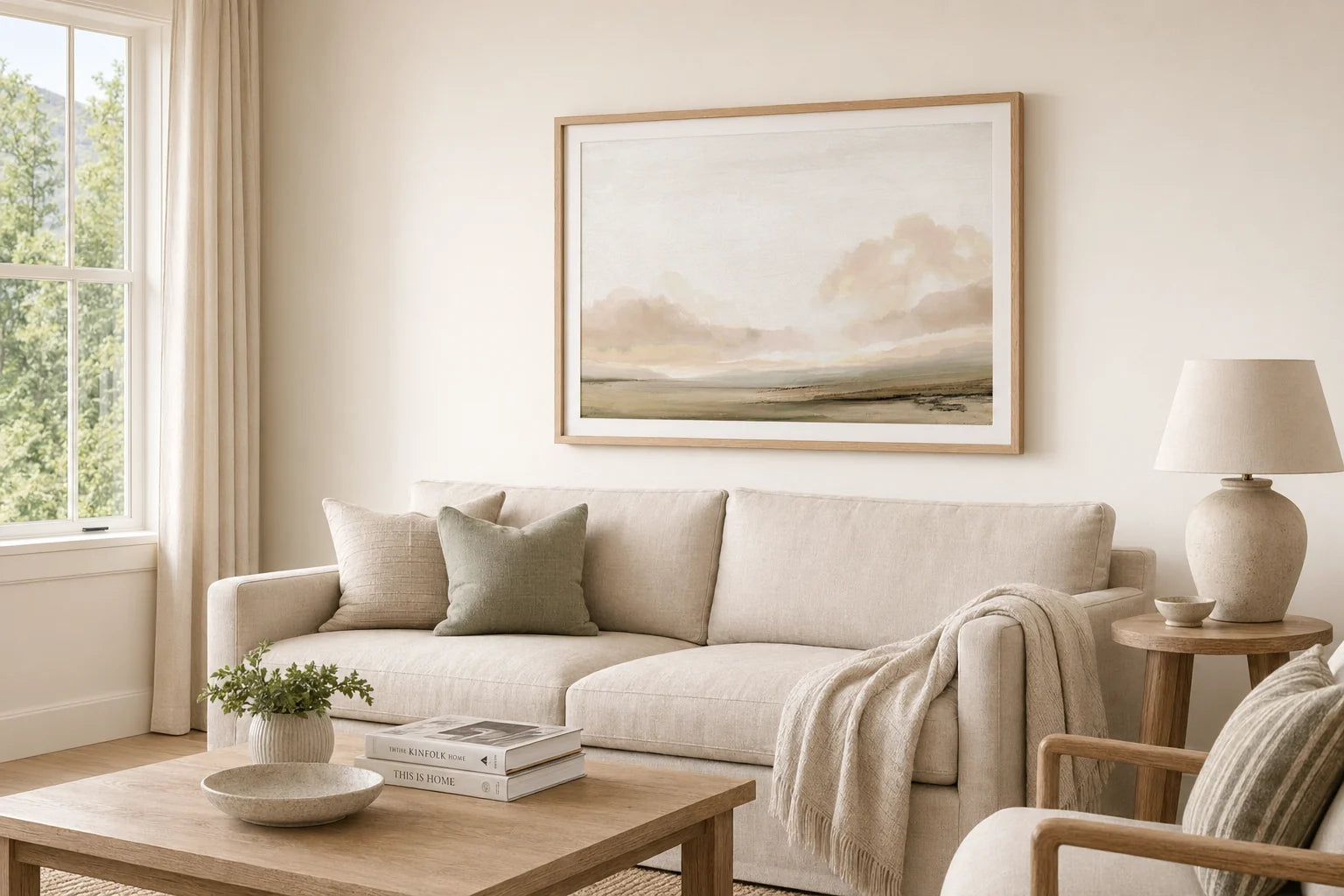
Southern Horizon Calm — Fine Art Paper behind UV-filtering glass, hung on a north-facing wall with light reaching the wall but not the print itself. The kindest light a print can hang in.
What fading actually is
Fading is photochemistry. Ultraviolet light breaks down the molecular bonds that hold pigment or dye colour together. The colour doesn't disappear evenly — magentas and yellows shift first, cyans last, which is why old prints often go cool and slightly blue before they go pale. Heat and humidity accelerate the process. So does ozone, which is why prints near gas hobs or busy roads age faster than the spec sheet suggests.
Pigment-based inks, like the Epson archival pigments we use on every Stone & Gray print, are far more resistant than dye inks. The pigment particles sit on the paper as suspended solids rather than dissolved into the fibre — UV has more work to do to break them apart. But _more resistant_ is not _immune_. Given enough light, anything fades.
What the archival rating means
Wilhelm Imaging Research is the independent lab most print studios cite. Their methodology accelerates ageing by exposing prints to controlled light conditions and extrapolating a display rating — the number of years before noticeable colour shift under typical indoor display.
For pigment prints on cotton-rag paper behind UV-filtering UV-filtering glass, the Wilhelm rating is generally 100 to 200+ years. Behind plain glass without UV filtering, halve that. With no glass at all, halve again. For a stretched canvas, where the surface is exposed but the pigment is the same, expect 75 to 150 years displayed indoors with reasonable light control.
These numbers are honest, but they assume reasonable conditions. They are not a promise that every print will hit a century. They are a baseline.
Archival doesn't mean immortal. It means the print starts with a hundred-year ceiling — and then the wall, the glass, and the light decide how much of that century it actually keeps.
— A Note from the Studio
South African light is not neutral
The Highveld and the Cape have some of the strongest UV indices in the world. A summer afternoon in Johannesburg or Stellenbosch is, photochemically, brutal. We've seen high-street dye-ink prints lose meaningful colour inside two years on west-facing walls.
The orientation of the wall matters more than most people think. In the southern hemisphere, north-facing walls receive the most direct sun across the day, but the light is even and predictable. East-facing walls take a hard, low-angle morning sun that is particularly damaging. West-facing walls catch the worst afternoon light. South-facing rooms — cool, indirect, often considered the dimmest — are where archival prints live longest, frankly.
The studio bias: hang anything you want to keep on a south or sheltered north wall, behind UV-filtering glass, away from any window where direct sun lands on the paper for more than an hour a day. That's the formula.
| Display condition | Pigment giclée on cotton-rag | Dye-ink high-street print |
|---|---|---|
| Behind UV-filtering glass, indirect light | 100–200+ years | 20–40 years |
| Behind plain glass, ambient indoor light | 60–120 years | 10–25 years |
| Unglazed canvas, indirect light | 75–150 years | Not typically applicable |
| Direct afternoon SA sun, no UV glass | 10–25 years to visible drift | 2–5 years to visible drift |
Estimates derived from Wilhelm Imaging Research methodology. Real-world results depend on UV intensity, glazing quality, temperature stability, and ozone exposure.
How to slow fading meaningfully
Four things, in order of impact. UV-filtering glass is the single largest gain — a good museum-grade glazing blocks 97 to 99% of UV and roughly doubles a print's effective lifespan. Standard glass blocks some UV but not enough to matter on a sun-facing wall.
Position is the second. Move a print one metre away from the window it currently sits beside and you've meaningfully reduced the daily UV dose. Rotate the print between two walls every few years if the home has a sunny side it can't avoid.
Stable temperature and humidity is the third. Cape Town's coastal humidity is hard on unframed paper; the Highveld's dryness is hard on unprotected canvas. A framed print behind glass largely solves both. Avoid hanging anything directly above a heat source — fireplaces, heaters, kitchen extractors — where temperature swings and ozone do quiet damage.
The fourth is the print itself. Pigment over dye, cotton-rag over coated photo paper, archival over commercial. The decisions made before a print reaches the wall set the ceiling on how long it can possibly last.

Worried about a sunny wall?
Send Nikki a photo of the room and the time of day the sun lands on the wall. She'll suggest whether to specify UV-filtering glazing, switch substrates, or rethink the position. Quietly, no obligation.
Message Nikki on WhatsApp →


