





Is fine art paper better than canvas for prints?
No — and that question, honestly, is the wrong one. Paper and canvas do different jobs. Our 230gsm ultra-matte Fine Art Paper holds detail and softens a room. Our 260gsm poly-cotton canvas carries weight and steadies one. The right answer depends on the artwork, the wall, and the light falling on it — not on which substrate is _objectively_ better.
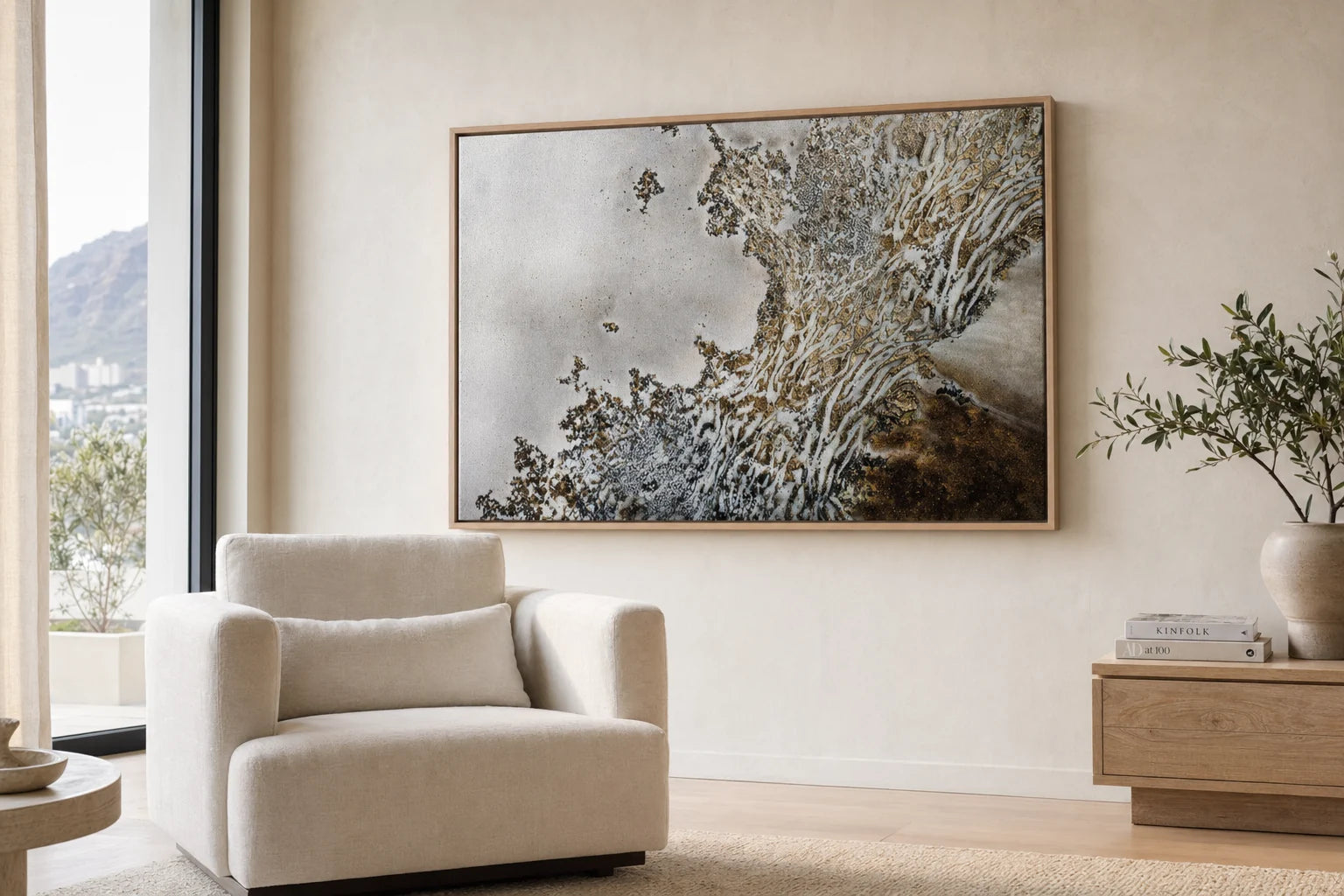
Aztecs Whispers — printed on our 260gsm poly-cotton canvas, mounted into a slim Beechwood floater frame. The canvas weave reads as authentic; the surface catches light the way the original would.
What we actually print on
Stone & Gray uses two substrates and only two. Fine Art Paper is a 230gsm ultra-matte cotton-rag, printed in our Woodstock studio with Epson archival pigment inks via the giclée process. It holds an enormous amount of ink, which is why detail and colour stay true to the original file. The finish is soft, completely matte, no glare under a downlight.
Canvas is a premium imported 260gsm poly-cotton blend — chosen deliberately, because it's what lets our advanced printing technology deliver vibrant colour, sharp detail and a rich texture that brings the artwork to life. It still has a quiet, velvety hand, nothing like the thin, plasticky canvas you find at chain stores. We print it on the same Epson pigment system, then either mount it plain over a 35mm Obeche timber stretcher or float it inside a slim frame in White, Black, Beechwood or African Teak.
Both substrates are archival. Both are made the same way, ten minutes from our front door. The difference isn't quality — it's character.
| Quality | 230gsm Fine Art Paper | 260gsm Poly-Cotton Canvas |
|---|---|---|
| Finish | Soft matte, no glare | Velvety matte, slight weave |
| Best for | Photography, line work, detail | Tonal abstracts, painterly work |
| Best rooms | Lounges, bedrooms, dining | Studies, hallways, stairwells |
| Framed with | Matte board + glass + timber | Plain mounted or floater frame |
A working comparison. Both substrates use Epson archival pigment inks and the same giclée process — the difference is character, not quality.
Paper softens a room
Fine Art Paper, framed behind glass with a generous matte border, reads as gallery. It's the finish that tells a wall to behave. In our experience, paper sits best in living rooms, bedrooms, dining rooms — the domestic spaces where you want a print to feel composed rather than declarative.
Detail is paper's other gift. Photography, botanical illustration, fine line work, anything with delicate gradient — paper holds it without interference. There's no weave underneath the image to compete with what's on top. If a piece relies on its precision, paper is almost always the right call.
The the matte board is part of the equation, too. A 30 to 50mm matte border around an A2 print does more for a room than most people expect. It gives the artwork breathing space and the wall a moment of pause.
Paper softens a room. Canvas steadies one. Neither is better — they're answering different questions about the wall in front of them.
— A Note from the Studio
Canvas steadies a wall
Canvas carries weight. We mean that physically — a stretched canvas projects 35mm off the wall and casts a soft shadow — but also visually. A large canvas anchors a hallway, a study, a stairwell, a generous blank wall above a console. It tells the eye where to land.
Tonal abstracts and reproductions of paint-on-canvas originals belong here. The canvas weave reads as authentic; the surface catches light the way the original would. A muted ochre abstract at A1 on canvas in a floater frame is one of the quieter, more confident choices we sell.
The floater frame is the canvas equivalent of a matte board — a slim border of negative space that lifts the image without enclosing it. No glass, no glare, no reflection. Casual luxury, frankly. It's our most-requested finish for the larger sizes.
How to choose between them
Our short version: if the artwork is detailed, photographic, or built on precision — choose paper. If it's tonal, painterly, or large enough to need to hold a wall on its own — choose canvas. If the room is soft (bedroom, lounge), lean paper. If the room is structural (study, hallway, stairwell), lean canvas.
Light matters too. Rooms with a lot of direct afternoon glare benefit from paper's matte finish behind UV-filtering glass. Rooms with low, ambient light — north-facing studies, evening lounges — let canvas show its texture without compromise.
And size shifts the answer. Below A2, paper almost always wins on detail. Above A1, canvas earns its keep by giving the piece visual mass. The decorators we work with most often will mix both in a single home: paper in the bedrooms, canvas in the entry. The house feels considered for it.

Not sure which finish your wall wants?
Send Nikki a photo of the room and a link to the artwork you're considering. She'll tell you honestly whether paper or canvas suits — and at what size. No pressure to buy.
Message Nikki on WhatsApp →


