





What is the difference between a giclée and a regular print?
A giclée is three things at once: pigment-based ink, a 12-colour archival printer, and acid-free paper or poly-cotton canvas. A regular print is usually dye ink on standard paper, run off a commercial offset press. The first is built to last a century behind glass. The second begins to drift within a few years. The word matters — it just isn't always used carefully.
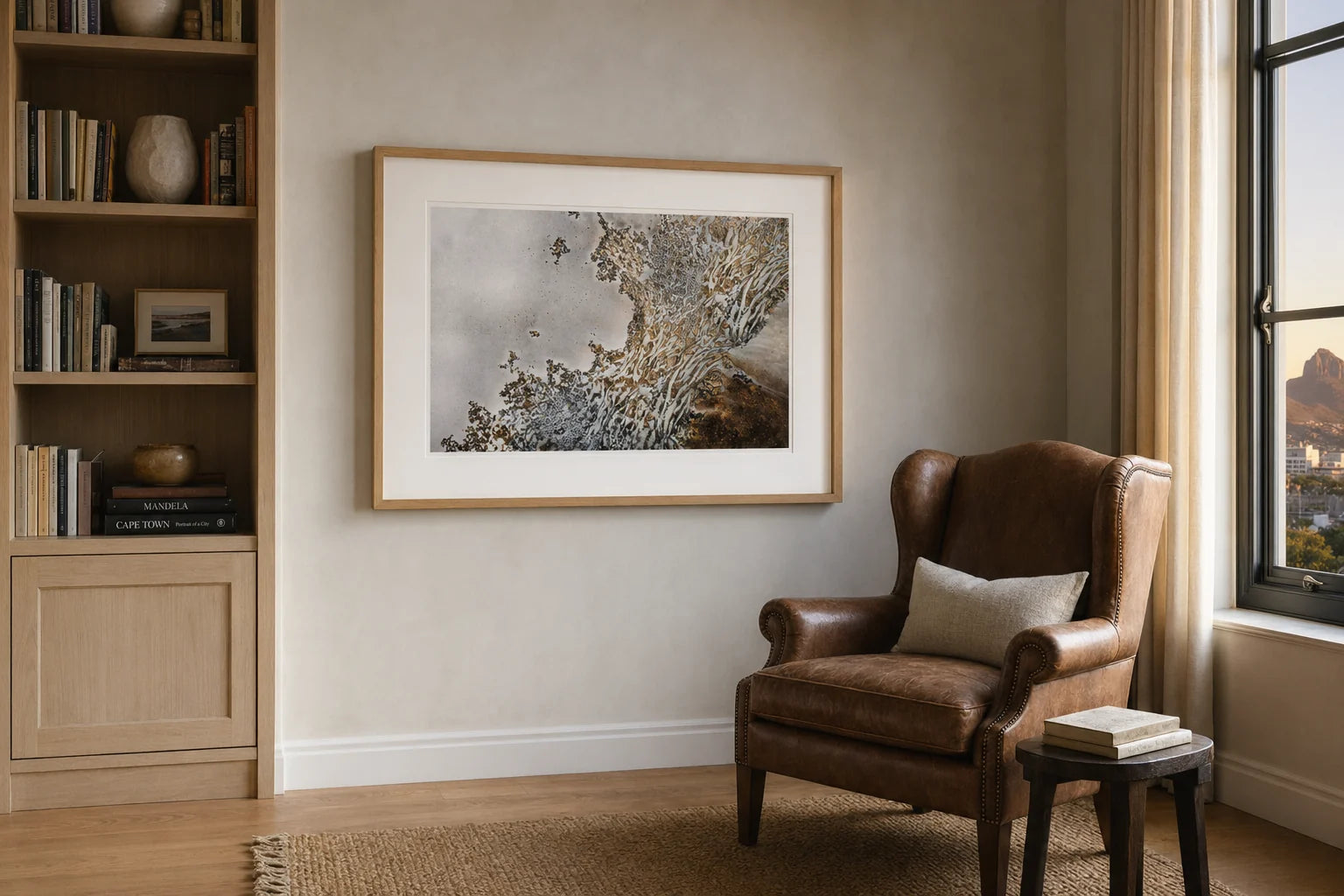
Aztecs Whispers — A1 Fine Art Paper giclée, framed in slim white oak with a 40 mm matte board. Printed on a 12-colour Epson SureColor pigment system in the Woodstock studio.
Where the word comes from
Giclée is French — it means, roughly, _to spray_. The term was coined in the early 1990s for a then-new generation of inkjet printers that could spray microscopic droplets of pigment ink onto archival paper at resolutions fine enough to rival a hand-pulled lithograph. It was a printmaking term, not a marketing one.
Today the word gets used loosely. Some retailers call any inkjet print a giclée. We don't. In our usage — and in the usage of every serious print studio we know — a giclée requires three specific things working together. Drop any one of them and the print is something else.
The three things that make a giclée
First, the ink must be pigment-based, not dye-based. Pigment particles sit on the paper as tiny suspended solids; they don't dissolve. Dye inks are absorbed into the paper fibre and begin to shift the moment UV touches them. The difference shows up in years, not days, but it shows up.
Second, the printer must have a wide colour gamut — typically a 12-colour system. We use Epson SureColor pigment printers in our Woodstock studio. The extra ink channels (light cyan, light magenta, three blacks, an orange, a green) are what allow a giclée to reproduce subtle gradients in skin tones, sky, deep shadow. A four-colour CMYK office printer cannot do this, no matter how high the resolution.
Third, the substrate must be archival. Acid-free, designed not to yellow over time. Our 230gsm Fine Art Paper and 260gsm poly-cotton canvas both qualify. Standard glossy photo paper from a chain store does not.
Pigment, twelve colours, archival paper. Drop any one of those three and the print is something else — usually something disposable.
— A Note from the Studio
| Specification | Giclée (Stone & Gray) | Regular print (high-street) |
|---|---|---|
| Ink type | Pigment, archival | Dye-based |
| Printer | 12-colour Epson SureColor | 4-colour CMYK office or offset |
| Paper | 230gsm cotton-rag, acid-free | Coated 150gsm, not acid-free |
| Colour gamut | Extended — subtle gradients hold | Compressed — banding visible |
Wilhelm Imaging Research provides independent permanence ratings for archival print systems. Figures assume indoor display behind UV-filtering glass.
What a regular print usually means
The phrase _regular print_ is broad, but in retail it almost always points to one of two things. Either an offset litho print — run in commercial volumes on a four-colour press onto coated 150gsm stock — or a dye-ink inkjet print on standard photo paper. Both are perfectly fine for a poster you're going to replace in two years.
Neither is built to age. Offset prints use dye-based inks that begin to shift colour under any UV exposure. The paper is rarely acid-free; it yellows. The R 95 frame-and-print bundles you see in homeware shops are this category. There's nothing dishonest about them — they're decorative, disposable, and priced accordingly.
A giclée operates differently. The intent is for the print to outlive the room it's hanging in.
Why the distinction matters
Two practical reasons. First, colour fidelity — a giclée reproduces what the artist actually painted or photographed, within a fraction of a percent. The original work and the print, hung side by side, agree. A dye-ink print drifts toward magenta and loses shadow detail almost immediately.
Second, longevity. Wilhelm Imaging Research, the independent lab that rates print permanence, gives Epson pigment prints on archival cotton-rag paper a display rating of 100 to 200 years behind glass, indoors, away from direct UV. A dye-ink print on standard paper is rated in single digits to a few decades, depending on conditions.
This isn't an academic distinction. If a print is going to live on a wall for a decade or be passed to a child, the substrate and ink decide whether it still looks like itself.

Want to know how a print is made?
Nikki is happy to walk through the actual files, inks, and paper choices behind any piece on the site — or send sample swatches of the 230gsm paper and 260gsm canvas to see in person.
Message Nikki on WhatsApp →


