



Why is giclée so expensive?
The honest answer is that the materials are genuinely costly — pigment ink cartridges run R3,000–R6,000 each, archival paper is sold by the single sheet at a premium, and the printers themselves cost upwards of R150,000. Add craftsmanship, framing, and the gallery infrastructure that gets the print to the wall, and the price reflects what's actually in the box. There's a markup, of course. But the floor is high to begin with.
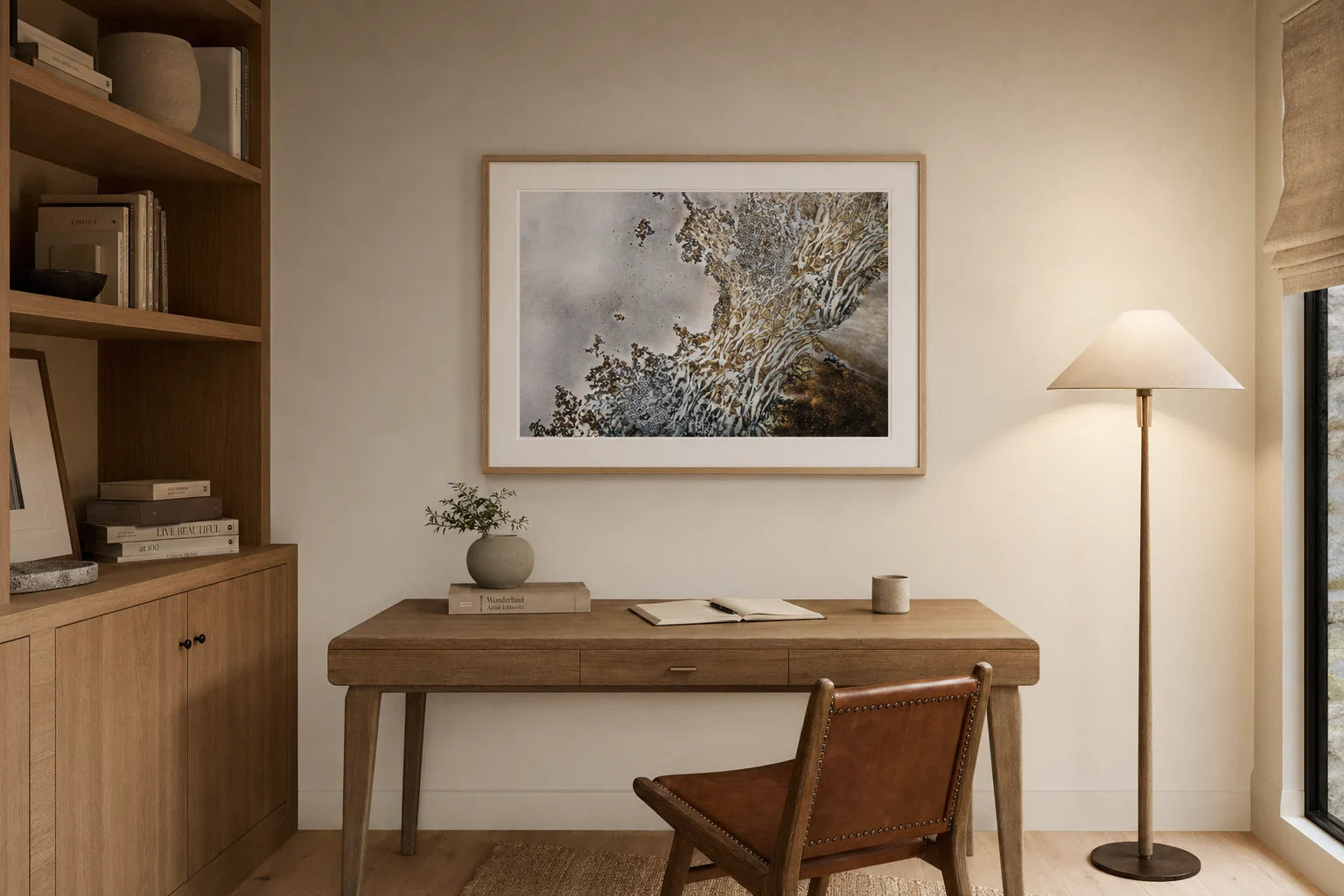
Aztecs Whispers — A1 Fine Art Paper, white oak frame, 40 mm matte board. The cost reflects the materials — pigment ink, archival cotton-rag paper, and a calibrated 12-colour printer that holds tone for a century.
The ink is the line item people underestimate
Pigment inks — the ones that don't fade for 75–100 years — aren't dye-based. They're suspended particle inks, made for a specific subset of large-format printers. A single cartridge for our Epson runs between R3,000 and R6,000, and a printer uses 9 to 12 cartridges in rotation.
An A1 print, depending on coverage, can pull a meaningful percentage of ink from those cartridges in a single pass. It's not the dominant cost, but it's not trivial either — and it's the cost most customers don't see when comparing a giclée print to a R95 mall print on dye-based ink.
Archival paper is sold by the sheet
The 230gsm cotton paper-based fine art paper we use isn't bought by the ream. It's bought by the sheet, or in single rolls priced as art supplies — because that's what it is. A single A1 sheet of archival fine art paper, before printing, costs more than the entire framed print at a chain store.
The 260gsm poly-cotton canvas we stretch is the same story. The substrate alone — before the image is on it, before it's stretched, before it's framed — represents a meaningful slice of the final price. That's the cost of materials that hold their tone for a century.
We could make this cheaper. We'd have to use dye ink, thinner paper, and a printer that costs a tenth of ours. The result would look fine for a year.
— A Note from the Studio
The printer, and the person operating it
A professional large-format giclée printer — the kind capable of producing archival prints at A0 with consistent colour calibration — costs R150,000 and up. It needs to be calibrated regularly. It uses paper handling, ICC profiles, and colour-managed workflows that take training.
This is the part of the cost that's invisible. You're paying for the studio that owns the equipment, the technician who calibrates it, and the studio's confidence that the print on your wall matches the artist's intent. A cheaper print isn't necessarily a worse image — but it almost certainly hasn't been through that pipeline.
| Cost component | Why | Order of magnitude |
|---|---|---|
| Pigment ink | Archival, fade-resistant, particle-based not dye | R3,000–R6,000 per cartridge |
| Archival paper | 230gsm cotton, sold by the sheet | Premium per sheet Sold as art supply |
| Poly-cotton canvas | 260gsm, stretched and finished by hand | Premium per metre Stretched in studio |
| The printer itself | Large-format, colour-calibrated, ICC-profiled | R150,000+ Plus calibration |
The actual cost stack behind a giclée print — materials first, infrastructure second.
Framing, finishing, and the gallery markup
Honestly, we'd rather acknowledge this than pretend it doesn't exist. There's a markup beyond materials and labour — the cost of the gallery, the website, the studio in Woodstock, the team that answers WhatsApp. That markup is what makes the difference between a print being available and a print being a viable business.
The frames are part of the same logic. A 22mm × 35mm Obeche timber frame is hand-finished. The cost reflects the joinery and the finish, not just the wood. We could ship cheaper frames; we'd rather not.
What the price actually buys
The reasonable answer to "why is this expensive" is: because it'll still look the same in 75 years, the materials cost what they cost, and a small studio is making it by hand in Cape Town. The unreasonable answer would be to claim the print is somehow cheap-but-superior. It isn't cheap. It's priced fairly for what it is.
Whether that price is worth it depends on the room — and on whether the print is being bought to live with for decades or to fill a gap until something better arrives.

Want the cost broken down for a specific size?
If a print is sitting in your basket and you'd like to understand exactly what you're paying for — the paper, the ink coverage, the frame finish — we'll walk you through it. No upsell. Nikki answers from the studio.
Message Nikki on WhatsApp →


